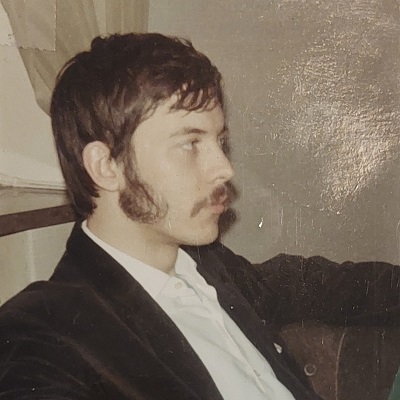

.

Ironi och Existens , 1983.
Kaj Bernh. Genell 1972, on piano ( live playback ) & clarinet. ( blues chords )
Kaj Bernh. Genell was born in Gothenburg, Sweden, in 1944.
After having survived a troubled youth, he soon became
interested in literature and philosophy and, in 1983, after several years of study at the University of Gothenburg, published a book
exclusively on existential ( in the Sarteian sense of the word ) Irony - “Ironi och existens.”
Soon hereafter, Genell, who since his teens had a great interest in one of the giants of Modernism, Franz Kafka,
wrote a series of odd papers at the University Gothenburg related to Kafka. Partly under supervision of the
renown stark Marxist Kurt Aspelin, who then was a senior teacher and lecturer there at that time. This would later result in
“Kafka och det Kafkaeska” (2018), an essay in Swedish on the Literary Technique of Kafka,and then later -
published in English - an extended version of this book as “Kafka” (2021), - a book which is the main concern
of this very website.
As a fiction writer Genell started out, passionate, with books in the Swedish language, such as “Pistolen”, “Tavelstölden”,
“Tegelkrona och skönheten”, ”Höstdrama” and the horror story “Skjuta sig fri”.
In 2021,” A case for Armamente,” a small idyllic crime story set in Baltimore, USA. Then With “The Lion´s Disease,”
Genell has under his own name in his second English novel created a psychological and philosophical comment on
pandemics by describing an odyssey to Indonesia on a Bulk Cargo Carrier. - Reading a book is to look into oneself.
In 2022 Kaj Bernh. Genell became a stipendiary, by being awarded a large sholarship from Sveriges Författarfond
( National Fund for Authors ).
His main interest is in MYTHS.
NOTES ON MYTH
Kaj Bernhard Genell
The Ancient Greek Empyrean, in the middle of 500 BC.
2.) Aristotelian-Christian-Dantesque Empyrean.
In the Empyrean above the waters, angels sit in several tiers, and at the very top, like in a small alcove, God himself reigns "on the cherubs" - Ps 80:2, 99:1; Isa 37:16. The concept appears in literature, as in Dante’s Divine Comedy in the last canto about Paradise. Dante finds God in the second circle before the Empyrean. See also Hieronymus Bosch (1450-1516).
"For the film, what matters primarily is that the actor represents himself to the public before the camera, rather than representing someone else."
This insight excellently illustrates the underlying idiocy of the modern Empyrean. But here we also have the gateway to the realization of modern narcissism, essence, and self-perception.
In comparing myth to other genres of representation, one might consider the temporal transition from religion to mysticism, as sketched out as a hypothesis by Gershom Scholem in his Jewish Mysticism. Scholem argues that it is only when religion has somewhat solidified and lost some of its aura, and similar accounts, that mysticism can arise, as a kind of rekindling.
In connection to this, one can see much of the reasoning put forth by Constantin Gulian in his work Mythos und Kultur as thought-provoking. There, the thesis from Jon de Vries is developed, which reads:
"We must consider that the need to find an explanation for myths only arose when belief in the gods was shaken."
The study of ancient dramas—such as the old Greek dramas—is sometimes also counted among the research of myths, and it is common in academic humanistic research, as these dramas are usually built on myths. The first Greek drama that was not based on a myth, and one of the few, is Agathon's play "The Flower."
One should – just for the saker of EXPERIMENT - think about who Homer, for example, truly was, and consider Homer in light of my earlier remark that Freud's theory was born on a plush chair, in the midst of bourgeois Vienna. One can assume—much points to that—that Homer in ancient Greece sat on something akin to a plush chair there. It seems incredible that his poems would have been preserved if he had not been in a context that resembled Versailles under Louis XIV more than a hillside in the Peloponnesus, surrounded by shepherds and bleating sheep.
Thus, Homer's 'transformation of the Greek pantheon' was a transformation in the direction of the precious and the ironic, away from the perception of the pantheon that the average person in the Greek context had. The religious world in which the priests of antiquity and the people lived has remained completely unknown due to history's concentration on the Homeric tales. By absorbing Homer’s salon version, it was assumed that this was the Greek "spirit," and not without reason. It suited perfectly to have this light-hearted story, to enable people to trust civilization. The power could not find a more delightful tale about an ideal society than the tale of the society where the Homeric worldview prevailed.
Just as Homer came to create a light-hearted image of the pantheon, Freud presented a simplistic view of the human psyche, where the dream, in an almost equally picturesque way as in the Iliad, haunted with figures resembling symbols, even hieroglyphic images, which were also tied to various myths from ancient Greece.
Seductive tales are not created in huts, in cafes, and in small shops. They are created on plush sofas and in affluent homes, by diligent creators, to then be sanctioned from the parlours of the powerful and super-rich.
Already early in Western civilization, people were outraged by myths; for example, the philosopher, the Roman emperor Julian ( who was born in Constantinople ) in the 4th century AD, who was struck down in battle after just three years in office, stated:
The myth is therefore not history. It is also not a symbol. A symbol is something monolithic. The myth is not a series of symbols, nor is it a story, but the myth is a SCENE for DISPLAY. In the early Wittgenstein's classic Tractatus, written during the First World War, W.'s entire theory of language is presented as a collection of pictures, and the linguistic proposition as an image ( W.'s theory of pictures). There are also a number of sub-theories and theories that have a relatively independent character. W. mentions, for example, a distinction between saying and showing. The proposition: "What can be shown, cannot be said."
Here Wittgenstein points out the great difference, the mutually exclusive difference, between, for example, telling someone how to cut Lena's hair and showing someone how to cut Lena's hair. Even if it were possible to describe in many words how to cut this hair (or do something else just as complicated), it is actually impossible to describe, to say, how to cut this hair, in the descriptive form that showing has, in that it shows how to cut the hair. One can never say the showing, so to speak. Saying and showing exclude each other.
So it is also with the myth, which in its tremendous schematic nature is not at all built to be narrated, just as much as it is, in its imagistic quality, intended to be represented with an image or a showing. In this respect, the myth is much less a statement than it is a display of an imagistic relationship. And thus something decisive happens with the message that the myth conveys. If the myth is something that is shown, like a haircut, then it is indeed shielded from criticism! One cannot say about the myth, which is exhibited on "the myth's stage," that: "That's not how it happened!" just as one cannot say about the person showing how to cut Lena's hair, that "That's not how you can cut her hair!" since her hair has just recently been demonstrably cut perfectly.
Thus, the myth, in that it almost instantly transformed into simple images, which were placed on walls and turned into friezes on temples, could not be objected to, as it showed more than it narrated. The form of the myth was to build a bridge between the obvious and the tale, in such a way that the tale appeared obvious. Here, less was claimed than merely shown. For the one who objected, the answer could come with a simple pointing to the image on the wall, the statue in the square, and the tattoo on the arm. The myth is therefore the least argumentative one can find. If one takes philosophical writings from the early centuries of our era, such as those of Josephus or Sextus Empiricus, and imagines the exact opposite of their persistently sophistic hair-splitting, one has the myth.
Aby Warburg - from the famous banking family in Hamburg, with roots in Hungary - long-distance relatives of the Gothenburg art and literature historian, Karl Warburg ( H. Schück's colleague ), - wrote the famous essay in anthropology and myth research about feathered snakes , the snake ritual ( the snake dance ) among the Pueblo Indians living in cliff dwellings in Arizona. Warburg had visited these in Arizona during a trip to the USA in 1895. Essentially while Warburg was drinking tea and bowing before the Pueblo Indians, and photographing them , German armies under General Trotha were massacring the inhabitants of German South West Africa – now Namibia – in a genocide that saw more than 60,000 Africans shot to death, others interned in concentration camps and stripped of their land.
Warburg's question was:
"What elements are we entitled to call the essential characteristics of primitive paganism?"
The essay - or lecture - has a suggestive power, which is further emphasized if one knows how vulnerable Warburg himself was while working on the project, haunted by anxiety and confusion, still not fully discharged from the mental hospital where he was treated. Warburg's lecture asks about the significance of myth not only for the human being who lived before Edison and Tesla but also for us. How shall we deal with the great questions of life without myths, without magical thinking and religion?
One of the most comprehensive and best lexicons of all the world's myths was perhaps written by Robert Graves. He had a firm notion that myth had been used for repressive purposes, but his main point - which he presented in The White Goddess: a Historical Grammar of Poetic Myth - was that it was up to poetry to revive the oldest part of myth, the cult of the moon.
( Benito Mussolini )
“Bolton adds the third function which is about establishing order of myths. Myths give a good image of the natural and social order. The universe starts with the creating of universe. After that, the myths show that the creation of human being and its society comes after the creation of the large universe. The Natural order is explained in the character and role of the God Zeus (Romans call him Jupiter). Myths depict Zeus (Jupiter) as the responsible for everything in the universe. He is believed to be the creator of such order in the universe.
Although, some gods have role in the universe and power among some phenomena, he is illustrated to be over all. He orders everything in the universe in its respective place. Social order has an important role in any societies. Any society must have a leader who has the responsibility to judge and shows people their roles in society. Each society has to be in order and every individual has to know his authority and must not exceed others’ authority. Otherwise, the individuals will fight each other and this society will be vanished as fast as possible. As people now have rules which establish the order of society, ancient people have rules establishing through myths. Myths reflect rules for the ordering of society. So myths are like a social charter which shows people what to do and what not to do. Like the responsibility of natural order, the social order responsibility is laid on the shoulders of Zeus (Jupiter) as well. He is stated as the judge who builds rules for maintaining order and justice. Moreover, he sets rules for punishing those who break these rules.”
Myth is peculiar when one looks closely at it; as Lévi-Strauss – the ethnologist and philosopher behind books like The Story of the Panther and The Jealous Potter – pointed out, myth and the parts of myth are such that no part in a myth is more important than another. Yes, one can indeed say about the myth - unlike historiography - that no PART is independently important, or that ALL parts are. Just as in a work of art. Through integrated totality, art operates. But fiction is then - as mentioned - while it is a myth, as a historical phenomenon, a creator of myth, in its diverse forms of either literature, visual art, or film, etc., etc.
Lévi-Strauss also asserts – in the preface to Le Cru et le Cuit – that myth interpretation is like a kind of anaclastic investigation: it is about refraction.
The most interesting anaclastic variant is perhaps the one, when a white light ray hits a thicker medium and diffractively splits into various colours; for one can indeed see this when a myth is processed through something that is not a myth, but a literary work, which in several respects can be considered a THICKER medium than myth, which is as fast as light, and always made so that it can be as light as possible. One can thus call it a THEORY OF REFRACTION when Freud’s thoughts are diffracted in the medium here constituted by Kafka's works. It is this process we are interested in, this anaclasticity. (cf. Fig.1.)
-----------------------------------------------------
"The main basic principle of the skeptic system is that of opposing to every proposition an equal proposition; for we believe that as a consequence of this we end by ceasing to dogmatize.”
( Sext. Emp. Outline, P.19 )
The most potent interrogative tool fiction has is irony. Irony - which in many cases may be unknown to the author - is fiction's most robust questioning, sceptical tool. A society without irony is in great danger. A community without irony has no correlator, no question, no creative negativity, no scepticism, no self-awareness, nor archaeology of the conscious or unconscious. Irony is also, by radically exposing, the key to knowledge of the unconscious and the current hallucination, and to the hallucination in our time. Hallucination is not isomorphic with a myth, but they have similarities.
Scepticism is fundamentally a defence against dogmatism. Irony is an attack on this. Through irony, the myth is unmasked, but irony also gives rise to more irony.
UNMASKING THE MYTH is – inevitably – a risky occupation. Since it is truly a redefinition of reality, it is open for debate about what is reality if we do not have any myths. Some people – if not all – will try to use this redefinition to their advantage. If we do not criticize the myths – after we have proven that the myths are instituted by malevolent rulers and bandits, oppressors and usurpers, why should we even discuss politics? If we talk about politics, we still have a world defined by old myths.
"Science must start with myths, and with the criticism of myths."
( Karl Popper )
Even culture itself has been subjected to such an extension that it is a fetish in itself. Redefining the world by claiming that the myths about NATIONS, & character and folklore are mostly propaganda is a prerequisite for a world where democracy can thrive as the sole important means to achieve universal peace.
"We choose Ithaca, the loyal land, the bold, clear thought, the clear-sighted action, the personality of the one who knows./…../ that conquers what we already own – the scant fresh crops in the fields, the brief love on this earth."
(Camus, L'Homme Revolté)
One might - apropos our beloved and necessary irony - think about how Anna Freud despised irony. Perhaps it was difficult for someone who had been raised as a mouthpiece for a theory to embrace the flagship of the sceptical doctrine?
Through the ages the conservative right has always emphasized the importance of the mythical domain, to make people slaves of historic, superficial bonds, to try to make a particular group of people believe that they are superior. The answer is about anti-myth work!
Myths are able to magnify some trivial gang fights of almost no historical significance. Such a deception is often dealt with, but under another star, by professors of literature across the Western academic world in the form of the Homeric question. Few people have realized that what we are dealing with in the Iliad can be compared to today's gang fights in the suburbs, where boys around 14 or 15 years old are involved (regarding the weaponry used in the Iliad, it is sticks). The most reliable source, a contemporary one, of what it was all about is probably the historian Herodotus ( d. 425 BC ) when he informs us about the number of inhabitants of the city of Troy. This city had about 2,000 inhabitants. Taking away mothers, children, and grandparents, not to mention all the wise boys who thought it was a bad idea, we are left with a couple dozen gangsters. They can easily fit in the café in my neighbourhood.
The Trojan War was – just to speculate - no more than a brawl in size when the boys in a house in my suburb got angry at the boys in another place for having been too loud when they celebrated the victory of the latest football match, or when they had too large an engagement party for a popular girl. Some real weapons were not owned by the boys with the wooden boat. They had felled some trees to make wooden sticks. Pelion's spear was the biggest stick they had. I can assure my reader that there are a few discussions about Pelion's spear in the Pentagon! Pelion’s spear was a tree that had grown on the mountain of Pelion, and it was believed that felling it could scare one's opponent. The gang that set out to attack the "castle" of Troy brought a couple of horses and some rowing boats. One could imagine the little children running around with pots on their heads. When it comes to all the gods in this remarkable story, they were of course in reality all older, uncles, aunts, and sisters as well as all the toothless alcoholics that the gang had left behind, but who entered their minds because they occasionally felt so guilty about having left them without support. For they ought to be supporters for them, you know. Grandfathers and uncles following the gang from a distance could not help but indefatigably interfere in all sorts of matters, which older people usually did. The goal of the daring gang leaders, like Agamemnon and Achilles, was to set upon the poor little Hector, who had had a bad reputation in all neighbouring areas for months. They landed Philoctetes on an island, as he was feeling ill.
It is a good story, thanks to the genius with the helper dog, Homer, who used to sit under a tree during years of drought, floods, and plague, and do nothing.
Few literature professors have been able to discern the scale of the events behind the tale and have thereby missed the true genius of the boy with the helper dog. I love the images he gave us of Eos with her thousand rosy fingers, which were thus named rosy fingers!
The professor missed the mythologization. Throughout all ages, since Denisova, people have invented stories like the Iliad to magnify themselves, their relatives, and their groups. Feed them with myths!
Even a brawl over the beautiful girl living next door, who eloped from Greece to Turkey with her lover, can be made into a fantastic story, a great epic!
But Homer’s tale did not achieve what is crucial in literature. It did not demythologize. It may have humanized the gods, but not enough for the ancient Greek reader to understand that there are no gods. The Iliad does give joy, which is also something good. In my opinion, demythologizing is what literature should effectuate, apart from the joy of beauty. These two things are what this book is about. Literature in the future should deal with and deliver these two things.
The Soul of Things
ANOTHER KIND OF MYTH is... let’s say... the myth that the great seafaring ship has its own will. Or the car on the road, our body, or that every book writes itself. The sailor does not sail; the ship sails by itself.
THE SAILING SHIP. The solitary ship on the vast sea (the myth behind Moby Dick, An Outcast of the Islands, and The Mysterious Island ):
The ship is unsinkable and sails as if by itself. The background to all these books about seamen in remote places, fantastic ships with extraordinary powers, seas with infinite surface, can be found among all the men who have lived and sailed on these ships for years, all those who built them, and all those who are dependent on them. The ships are of genius construction, carefully assembled, with thousands of parts, wood or metal, tertium non datur, all with their fine names, and all cared for meticulously, every hour of the day, every season in its way, as if the rigging of the ship were part of a theology, created by many centuries of marine priests. Every sail and everything that makes sails, and makes them large, turns the vessels into large sailing ships, serves to create the environmental backdrop to all the special, fateful moral problems on these gigantic wooden boxes under sail. Sailing ships have been the material foundation for countless people in round periods of time. While storms and wars pass by, they continue to sail in remote waters, carrying their goods and their mythology, alluring and elusive. Some aboard these ships know that these ships live and breathe. The waves crash against the hull. The ship sometimes sails by itself. Not just The Flying Dutchman, oh no! Every ship always sails by itself. That someone steers is merely an illusion.
(Albert Pinkham Ryder, The Flying Dutchman )
Myth is a phenomenon of an ideal kind, an ethereal trivia that people come up with when they need something they do not have. Myths are what we have and do not have. It is believed that myths and legends have existed since the Age of Dinosaurs, but that could also be a lie. Many just wished for instance that their country had a myth - and believed that humanity could not imagine anything about itself and its place on earth without having a myth to relate to. Others believe that the myth is created by those who have something to gain by creating the particular myth. Many people still wave flags today. Thus, the myth of the rain god and the rain man, of the wicked man and the man with the evil eye, and the myth of the good, and the myth of the two eternally loving, and similar, created by kings and priests, who realized that they would gain an advantage if the myth spread among their fellow humans.
Thus are the myths of great ships without crews, themselves great ships without crews, mass-produced - and they are after the kings and priests have died - eventually completely rudderless stories. The historical centenary tonnage, our everything, rests weightless and rudderless in the sea, which derives its coldness and light from the space above, and its bitterness and metallic taste from the alimony layers in the Earth's interior.
Defenders of myths often claim that people need myths, and that it is impossible to understand the world around us, if we do not have these myths. Only that they themselves do not require these myths to understand anything. The need is always ascribed to other people. THEY need myths.
It is about the same lie that is evident when people claim that children need children´s books. They do not. It is the authors of children´s books that need children´s books!
But what about The Flying Dutchman?
This is an example of a most astonishing and catching myth. There are many versions circulating, but it often goes: sailors tries to seek shelter in a distant port to avoid a hideous storm. They are denied entrance, and the ship vanishes, but is then seen by sailors all over the world, apparently sailing without any crew.
Other versions goes: the captain of the ship has committed hideous crimes and God does not permit him to go ashore, but every time the ship comes near a port, the wind turns against the ship and drives it away out in the ocean.
There are other versions too, and it is not a very old myth, but the phantom ship with no crew is a common denominator.
KIERKEGAARD, CAMUS. FREUD and MYTH and HORROR
WITH HORROR, Kierkegaard also regarded how myths, with horror—not least through Christianity—shaped the world. One of his earliest books, all published within a few years in the early 1840s, which dealt with this, was his Fear and Trembling. Here, the story of Abraham and Isaac is treated, when Abraham receives orders from "God" to sacrifice Isaac. This horror story is also of the type "The train has left, the journey is over." Much like the Kafka parable Before the Law. Kierkegaard's excellent treatment of the story, which concludes in the belief in the absurd ( that Isaac would nonetheless be saved by God ), leads him to believe in something that one might call "redemptive horror." Kierkegaard both hopes that he demythologizes and does not. He writes himself: "Oh, when I one day am dead, that book, Fear and Trembling, will be enough to make me immortal. Then it will indeed be read and translated into countless languages. The reader will literally shrink before the terrifying pathos in the book." … Søren Kierkegaard, who of course suspected that the horror in the book actually came from the fable it treated. The paradox faith, the paradoxical faith in Jesus as a paradox! The superposition of paradox—and the belief in the absurd is of course completely intellectually dishonest. Bertrand Russell simply called Kierkegaard a romantic.
It is interesting how almost everything SK writes about is related to horror. But he was also raised in horror, by the blood-Christianity of the Herrnhut movement and by his father, Michael P. Kierkegaard, with his paranoia directed at an invisible being …, the father who believed that his existence was a form of punishment from the invisible … because as a young boy, working as a shepherd on the Jutland heath, he had climbed a hill and cursed God. The father told this later to the child Søren.
CAMUS AND HORROR
Camus was filled with the rebellious horror—real or constructed—before the absurd. In his books The Myth of Sisyphus and The Rebel ( L´Homme revolté ) . All of Camus' thinking about absurdity and revolt, in all its pretentious form and spirit — ultimately stems from some passages in Kojève's illustrious lectures on Hegel from the early 1930s, where K. elaborates on negation as the driving force in world history, as part of K.'s explanation of Hegelian dialectics.
Kojève defended authority, in itself, just as the one authority that ruled in his birthplace, the Soviet Union, worshipped the revolt that was seen symbolized in the communist system, where the goal of revolt was fulfilled, or at least a march. According to Kojève , authority was, of course, preferable to chaos since true authority is the one which one willingly submits to, just as the people in the Soviet Union did. Outside a system where authority reigns, one can only lean against the negation according to Kojève. In The Rebel, it is this eternal no, without authority, that Camus preaches. Sartre, who at that time was some communist, believed that Camus was pubescent, or at most in high school. In embracing absurdity, Camus thus positions himself under the question of absurdity itself, under the myth of Sisyphus, for this myth, while it explains that existence is absurd, also lifts from humanity the feeling of absurdity by naming existence ab-surd . This is of course absurd. Camus describes Breton's surrealism—its fusion of reality and dream—as the concrete irrationalism and the objective danger. Surrealism, with its defence of Nietzsche and return to ancient Greek values, has its enemy in rationalism, claims Camus. Camus and the idea of the absurd, which floated as a mantra in the 1960s, over time has had less influence. Kierkegaard's radical voluntarism: "The truth is to will one thing." … has been somewhat more enduring, even though its argumentation is nearly as weak as Camus'.
Camus is of course worse, since his point is that it is in some way an aristocratic and honourable act, to realize that every thing is absurd ( which indeed is nothing ) and still “want to live”. This positions commits nobody to anything, and is sheer hubris plus a giant neglect for truly suffering.
Horkheimer and Adorno—the creators of the Frankfurt School and Critical Theory—believed that they had come to an insight about the myth's circle regarding the analysis of the myth's dictates: enlightenment was essentially the same as myth. The moment enlightenment, reason in various ways rid itself of myth, which always supported the belief that it was possible to sort out all problems by using violence, thus through fascism, a new myth was created, by which one AGAIN decided that it was only with violence, through fascism, that one had the right to rid oneself of newly discovered myths, etc. There are always new reasons for a new authoritarian movement. Particularly in times of high technical refinement and great automation. Who really sees the human's place in such an environment? Who understands what is myth and what is reason? Who could, for example, see what is the small linguistic myth and what is the large ideological myth? Who could be heard amidst the birth of myth after myth? What is a demythologization? This analysis was criticized by Habermas, who probably perceived it as defeatist. Everything Adorno wrote came to be shaped, consciously or unconsciously, according to a strict, orthodox Marxist power analysis. The purpose of the Frankfurt School was revolution.
FREUD and the ANTROPOLIGISTS
It seems as though Freud mostly viewed the myth as a parallel to the dream: the myth as a kind of cultural clairvoyant phenomenon that could be decoded. ( There is really no limit to how much truth has been attributed to Myth, the most uncertain of all sources, as if all humanity, in the absence of anything else, turned to tales for guidance… The notion that the myth would be ridiculous does not even occur to anyone. ) But more on this later. On Freud's desk—both the one in Vienna and later the one in London—stood wooden, ceramic, and bronze statues en masse, illustrating mythical tales and conceptions of all kinds from nearly all the continents of the earth. ( Freud's chair, on the other hand, was more ergonomic. He is also said to have read with one foot entwined in one of its legs.) Myths are symbols that have gained elephantiasis, have grown out of their clothes and run amok. The more accurate analysis of the myth belongs to Malinowski, as he argues that the myth reflects social and historical conditions—which are always based on power. Nothing can be more trivial than to see myths as reflections from the depths of the folk psyche, which has been done for centuries by anthropologists and the like. Michelle Wallace, for example, argues that what Lévi-Strauss refers to as "myth" in books like Tristes tropiques, akin to Freud, is nothing more than "history." Exoticization. The traditional research journey.
What many anthropologists from old colonizing countries refer to as myth is probably only a distancing from history. They turn a blind eye to WHO wrote history and who ordered those who wrote it. They forget those who refrained from burning just THAT history book.
Lévi-Strauss also asserts that ethnography is psychology. One thus views societies as societies without power structures, but rather as a collection of figures wandering in a world of myths that obey the same underlying laws in all countries and at all times, a world defined by ethnographers/anthropologists. Africa—by example—had been divided among Europeans, under the leadership of Bismarck, at the Berlin Conference in 1884. Compare this to C. Jung's travels in Africa and India, where he perceives these countries as being populated by … children. With André Gide—the author of The Pastoral Symphony and more—it was different; in 1927, he followed in the wake of the cynical anthropologists and was shocked by the colonial abuses. The books Voyage in the Congo and Return from Chad gradually opened Europeans' eyes to what was happening in the French colonies and contributed massively to the anti-colonial movements in France.
Perhaps Freud's pyramidal collecting mania made him blind to what these historical artifacts actually carried in terms of peculiar, horrifying, and/or trivial backgrounds. The figures in wood, stone, or ivory instead immediately rose into a symbolic world where a place awaited them. What Freud nonetheless did was unveil myths in his own culture. Or at least in his cultural layer. He had no interest in workers, farmers, sailors, or other culturally uneducated people—except perhaps for soldiers. Among other things, he argued that national myths were nothing more than nonsense.
He also did not conduct a closer analysis of the nature of myth, which one honestly misses since it would have significantly crowned his work—to use a mythological image. The secret of the truth about the Myth is roughly this: The small myth, the myth in the Symbol, the purely expressive myth, the "dye-maker," is like a precious stone, exquisitely rare, or a "noble stone," and entirely essential for Humanity. It is the SMALL myth. Here, one can refer to the embryonic form of such a myth theory present in Lévi-Strauss's attention to the "mythème."
The Great myth, the thick symbol, the symbol with elephantiasis, the thick – GROSS - symbol, the swollen, deceitful, inflated, meta symbol, the system, the grand narrative, the great myth that is the skull of civilization, i.e., MYTH, the storm myth, psychopathology, the oppressive authority, is life-threatening and deadly, a poison, and what is understood for humanity. The art of dealing with this discrepancy, of keeping apart the rare diamond (the symbol) from the terrible skull (the larger myths)—that is what CULTURE is about, or should be about! Alas, may such a "science of Myth" soon be created! Perhaps one could soon, through a "refraction theory"—the theory of diffraction—for myths obtain a knowledge, a science that could tame the myth, even on a more mundane level. Primarily, the task becomes to catalogue and structure the two elements in the diffraction, the character of the origin myth, and its temporal position concerning culmination, as well as the character and temporal position of the processing myth, approaches, etc. What initially seems like a PURE platitude, that myths are dealt with in literature, or that they are treated in other media than the original, that one is treated by the other, might upon further consideration appear as a sesame open the door, regarding accessing what is corrupt in the myth, while at the same time saving what is beautiful and insightful as a Gyllenstiernski diadem.
------------------------
==============================================
Kaj Bernhard Genell. Gothenburg, 2025 © Copyright Kaj Bernh. Genell 2025. All rights reserved.

CONTACT: kajgenell at gmail.com